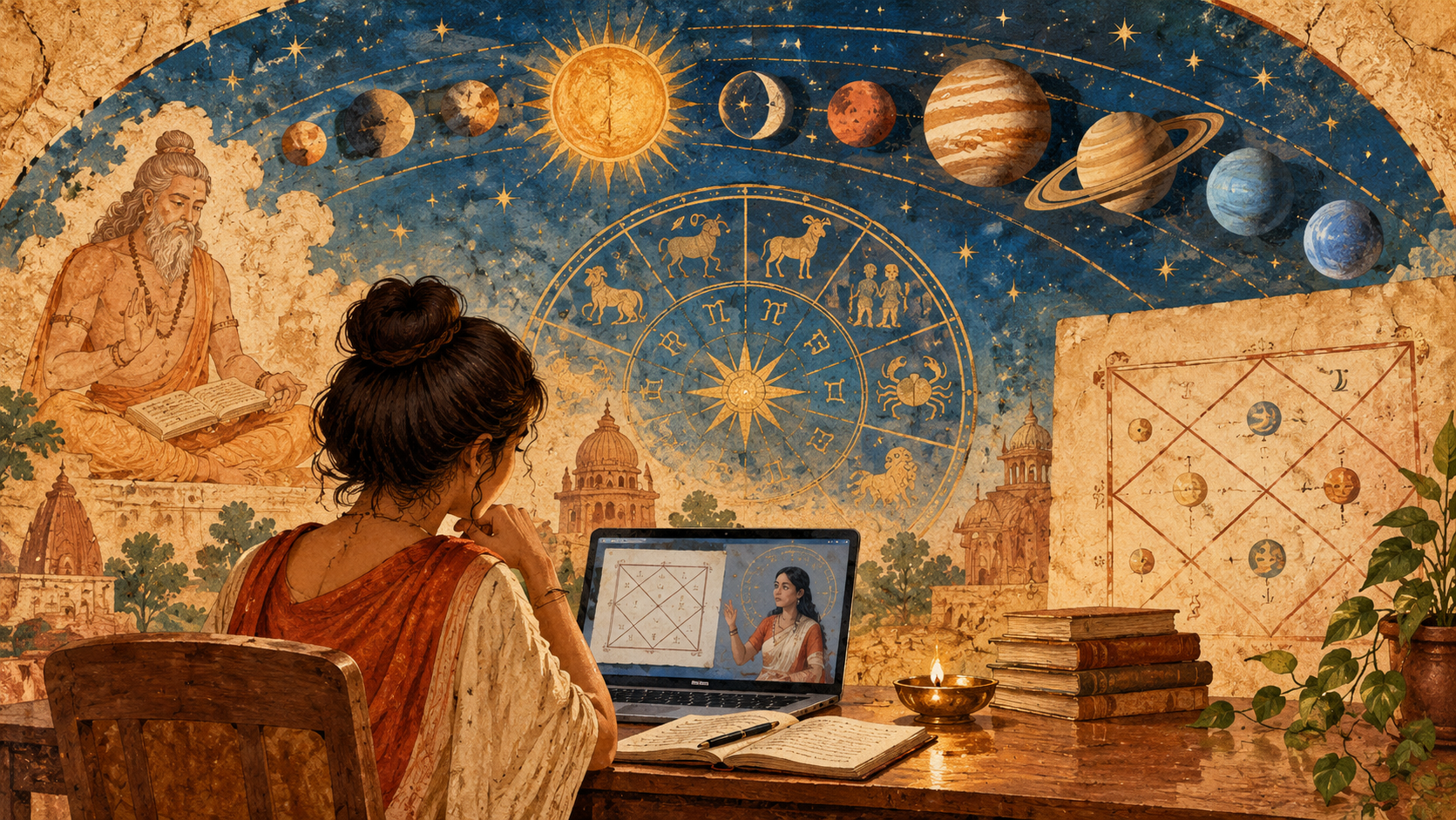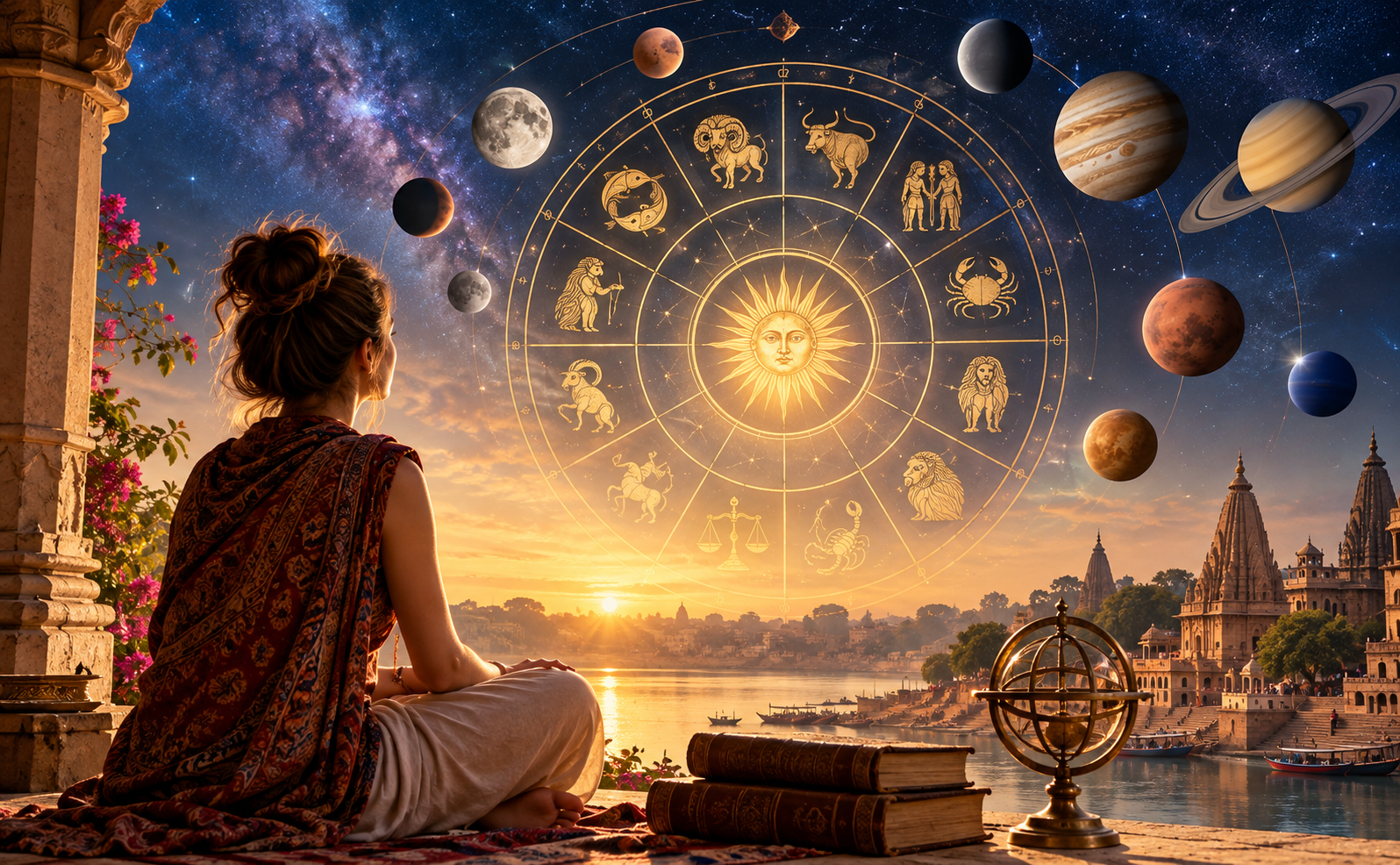
Have you ever wondered why two people born on the same day can have completely different personalities, life experiences, and challenges?
This is one of the questions that makes people curious about astrology.
Vedic astrology offers a detailed system for understanding the relationship between planetary positions, time, and different areas of human life. Unlike the simple daily horoscopes many people are familiar with, Vedic astrology works with a birth chart, planetary placements, zodiac signs, houses, and specific timing systems.
For beginners, however, the subject can initially seem complicated. There are planets, houses, signs, nakshatras, dashas, yogas, and many other concepts to understand.
The good news is that you do not need to learn everything at once.
This guide explains the fundamentals of Vedic astrology in a simple, structured way so you can understand how it works, what a birth chart tells you, and how to begin learning astrology yourself.
What Is Vedic Astrology?
Vedic astrology is a traditional Indian system of astrology that studies the positions and movements of celestial bodies and their relationship with events and experiences in human life.
It is traditionally associated with Jyotisha, a Sanskrit term commonly translated as the “science of light.”
At its foundation, Vedic astrology uses the date, exact time, and place of birth to create a birth chart, also known as a Janma Kundali.
The birth chart represents the sky at the moment of birth. An astrologer then studies the positions of planets, zodiac signs, houses, nakshatras, and other factors to interpret different areas of life.
These may include:
- Personality and temperament
- Education and learning
- Career and professional direction
- Relationships and marriage
- Finances and wealth
- Family life
- Health and wellbeing
- Spiritual interests
- Major periods of change
- Important life phases
The purpose is not simply to say that a particular event will happen. A serious study of astrology also considers why certain tendencies may appear, when particular periods become more active, and how different factors in the chart interact with one another.
Is Vedic Astrology the Same as Western Astrology?
Not exactly.
Both systems use astronomical positions to create charts, but they differ in several important ways.
One of the biggest differences is the zodiac system used.
Most forms of Western astrology use the tropical zodiac, which is connected to the seasonal cycle. Vedic astrology generally uses the sidereal zodiac, which takes the observable position of the stars into account.
Because of this difference, your zodiac sign in a Vedic chart may be different from the sign you know from a typical Western horoscope.
For example, someone who is commonly told that they are a Leo in a Western horoscope may have Cancer as their Moon sign or even a different Sun sign in a Vedic chart, depending on their birth details and the calculation method used.
This does not necessarily mean that one system is “right” and the other is “wrong.” They are different astrological frameworks with different traditions and techniques.
The Birth Chart: The Foundation of Vedic Astrology
If you are starting to learn Vedic astrology, the birth chart is the first major concept you should understand.
A birth chart is calculated using three essential pieces of information:
- Date of birth
- Exact time of birth
- Place of birth
The exact birth time is particularly important because the Ascendant, or Lagna, changes relatively quickly.
Even a difference in birth time can sometimes change the Ascendant or the house positions of planets, which may affect the interpretation of the chart.
The chart is divided into twelve houses, with each house representing different areas of life.
The 12 Houses in Vedic Astrology
The twelve houses form one of the most important foundations of chart interpretation.
1st House – Self and Personality
The first house represents the individual, physical appearance, personality, approach to life, confidence, and overall direction.
It is closely connected with the Lagna, or Ascendant.
2nd House – Wealth, Family and Speech
The second house is associated with accumulated wealth, family values, speech, food habits, and personal resources.
It can also provide insights into how a person communicates and manages finances.
3rd House – Communication and Courage
The third house relates to communication, courage, skills, writing, younger siblings, initiative, and personal effort.
It is often associated with the ability to take action rather than simply wait for circumstances to change.
4th House – Home and Emotional Foundation
The fourth house represents home, mother, property, education, emotional security, and one’s inner sense of comfort.
It can offer insights into the environment in which a person feels most secure.
5th House – Intelligence, Creativity and Children
The fifth house is traditionally connected with intelligence, creativity, education, children, romance, speculation, and self-expression.
It is also an important house for understanding one’s creative abilities.
6th House – Work, Competition and Challenges
The sixth house relates to service, employment, competition, debts, obstacles, conflicts, and the ability to overcome difficulties.
It is often studied when examining areas where discipline and consistent effort are required.
7th House – Marriage and Partnerships
The seventh house represents marriage, partnerships, business relationships, and interactions with other people.
It is one of the primary houses studied when examining relationships and marriage.
8th House – Transformation and Hidden Matters
The eighth house is associated with transformation, sudden changes, inheritance, secrets, research, shared resources, and deeper psychological experiences.
It is often misunderstood as simply a “bad” house, but its symbolism is much broader than that.
9th House – Dharma, Higher Learning and Spirituality
The ninth house represents higher education, teachers, philosophy, spirituality, long-distance travel, belief systems, and dharma.
It is traditionally considered one of the most significant houses in a Vedic birth chart.
10th House – Career and Public Life
The tenth house is strongly associated with career, profession, reputation, authority, achievements, and one’s contribution to society.
When people ask about career through astrology, the tenth house is usually one of several important factors examined.
11th House – Gains and Networks
The eleventh house relates to income, gains, friendships, social networks, ambitions, and fulfillment of desires.
It can show the types of environments and connections through which opportunities may develop.
12th House – Expenses, Foreign Lands and Spirituality
The twelfth house is associated with expenses, isolation, foreign countries, sleep, retreat, detachment, and spiritual experiences.
Its themes often involve letting go, withdrawal, or experiences beyond the immediately visible world.
The 9 Planets in Vedic Astrology
Vedic astrology traditionally works with nine primary planetary influences, known as the Navagraha.
These are:
- Sun (Surya)
- Moon (Chandra)
- Mars (Mangala)
- Mercury (Budha)
- Jupiter (Guru)
- Venus (Shukra)
- Saturn (Shani)
- Rahu
- Ketu
Rahu and Ketu are not physical planets. They are the lunar nodes, calculated points where the paths of the Sun and Moon intersect.
Each graha represents different principles and areas of experience.
For example:
Sun is associated with identity, authority, confidence, leadership, and vitality.
Moon represents emotions, mind, habits, sensitivity, and mental patterns.
Mars relates to energy, courage, action, competition, and drive.
Mercury is associated with communication, logic, learning, analysis, and commerce.
Jupiter represents wisdom, knowledge, expansion, teachers, and higher understanding.
Venus relates to relationships, beauty, creativity, comfort, luxury, and pleasures.
Saturn represents discipline, responsibility, limitations, patience, and long-term effort.
Rahu is associated with intense desires, ambition, unconventional experiences, and worldly fascination.
Ketu is connected with detachment, spirituality, past tendencies, and areas where a person may seek deeper meaning.
These meanings are only starting points. A planet’s actual interpretation depends on its sign, house, dignity, aspects, conjunctions, nakshatra, and the overall structure of the chart.
What Is a Nakshatra?
If you are beginning to explore Vedic astrology, you will eventually come across the term Nakshatra.
The zodiac is divided into 27 Nakshatras, or lunar constellations.
Each Nakshatra covers 13 degrees and 20 minutes of the zodiac.
While zodiac signs provide one layer of interpretation, Nakshatras add another level of detail.
The Moon’s Nakshatra is particularly important because the Moon moves relatively quickly through the zodiac.
Nakshatras are used in several areas of Vedic astrology, including:
- Personality analysis
- Compatibility
- Marriage matching
- Dasha calculations
- Understanding psychological tendencies
- Muhurta, or selecting an auspicious time
For beginners, it is usually better to understand signs, houses, and planets first before trying to memorize all 27 Nakshatras.
What Is the Ascendant or Lagna?
The Ascendant, commonly called Lagna, is the zodiac sign rising on the eastern horizon at the exact time and location of birth.
It is one of the most important points in a Vedic birth chart.
The Lagna helps determine the twelve houses of the chart and therefore influences how planetary placements are interpreted.
For example, Mars in the tenth house does not mean exactly the same thing for every person. The sign occupied by Mars, its lordship, aspects, conjunctions, strength, and the Ascendant all matter.
This is why simply looking at one planetary placement and making a prediction can be misleading.
A proper chart interpretation requires the whole chart to be considered as a system.
What Are Dashas in Vedic Astrology?
One of the distinctive features of Vedic astrology is its sophisticated approach to planetary timing.
This is where the concept of Dasha becomes important.
A Dasha is a planetary period that indicates which planetary influence is particularly active during a certain phase of life.
The most commonly used system is Vimshottari Dasha, which divides a 120-year cycle among nine planetary periods.
The sequence is:
- Ketu – 7 years
- Venus – 20 years
- Sun – 6 years
- Moon – 10 years
- Mars – 7 years
- Rahu – 18 years
- Jupiter – 16 years
- Saturn – 19 years
- Mercury – 17 years
Within a major planetary period, there are also sub-periods known as Antardashas.
This creates a detailed timing framework.
For example, instead of simply saying, “Jupiter is good for you,” an astrologer may examine whether a person is currently running a Jupiter Mahadasha, what Jupiter represents in the individual’s chart, and which sub-period is active.
This is one reason Vedic astrology can become quite detailed once you move beyond basic horoscope reading.
What Are Yogas in Vedic Astrology?
The word Yoga refers to a specific planetary combination.
Certain combinations are traditionally associated with particular tendencies or possibilities.
There are many types of yogas, including combinations associated with:
- Wealth
- Leadership
- Education
- Career
- Fame
- Spiritual development
- Challenges and obstacles
However, there is an important point beginners should remember:
A yoga should never be interpreted in isolation.
Finding a famous “wealth yoga” in a birth chart does not automatically guarantee wealth.
The strength of the planets involved, house placement, planetary dignity, aspects, dashas, and other chart factors all influence how a combination may manifest.
This is where experienced chart interpretation differs from simply identifying combinations from a list.
Can Vedic Astrology Predict the Future?
This is probably one of the most common questions beginners ask.
The answer depends on what you mean by “predict.”
Astrology is often used to identify patterns, tendencies, periods of opportunity, and periods that may involve greater challenges or change.
However, treating an astrological chart as a guaranteed script of everything that will happen can lead to oversimplification.
Human decisions, circumstances, environment, effort, and many other factors affect how life unfolds.
A more useful way to approach astrology is as a framework for understanding timing and tendencies rather than as a substitute for personal judgment.
For example, an astrologer may identify a period that appears supportive for career development. That does not mean success will arrive without effort. It may instead suggest that the period is worth using strategically.
How Accurate Is Vedic Astrology?
Astrology is a traditional interpretive practice, and its claims about predicting life events are not established by modern scientific evidence in the same way as scientifically validated methods.
This distinction is important.
If you are interested in Vedic astrology, it is reasonable to study it as a traditional knowledge system while maintaining a critical mindset.
A good astrologer should not encourage fear, dependency, or the belief that every life decision must be dictated by a horoscope.
The value many people find in astrology comes from reflection, pattern recognition, traditional symbolism, and a structured way of thinking about different phases of life.
How to Read a Vedic Birth Chart as a Beginner
If you want to start learning astrology, avoid trying to memorize everything at once.
A practical learning sequence is:
Step 1: Learn the 12 zodiac signs
Understand their basic characteristics and elemental qualities.
Step 2: Learn the 9 Grahas
Know what each planet represents before studying complex combinations.
Step 3: Learn the 12 houses
Understand what each house represents in a person’s life.
Step 4: Understand the Ascendant
Learn how the Lagna determines the house structure of a chart.
Step 5: Study planetary placement
Learn how the meaning of a planet changes depending on the house and sign it occupies.
Step 6: Learn aspects
Understand how planets influence other houses and planets.
Step 7: Study Nakshatras
Once the fundamentals are clear, move into lunar constellations and their deeper symbolism.
Step 8: Learn Dashas
This allows you to move from static chart interpretation toward timing.
Step 9: Study transits
Learn how current planetary movements are interpreted against the natal chart.
Step 10: Practice complete chart analysis
This is where theoretical knowledge starts becoming practical skill.
What Information Do You Need for a Vedic Astrology Reading?
A basic birth chart requires:
Date of birth: Day, month, and year
Time of birth: As accurate as possible
Place of birth: City and country
The birth time is especially important because the Ascendant and houses depend on it.
If the recorded birth time is uncertain, astrologers may use a process known as birth time rectification to investigate possible birth times using significant life events.
However, rectification is itself a specialized area and should not be treated as a simple adjustment of a few minutes.
Common Mistakes Beginners Make
Learning astrology becomes much easier when you know what to avoid.
1. Focusing only on the Sun sign
Your Sun sign is only one part of the birth chart.
2. Judging a planet as simply “good” or “bad”
Planetary results depend heavily on context.
3. Ignoring the Ascendant
The Lagna establishes the house framework of the chart and is fundamental to interpretation.
4. Making predictions from one placement
A single placement rarely tells the whole story.
5. Trying to memorize everything
Understanding relationships between concepts is more valuable than memorizing hundreds of isolated rules.
6. Learning only from social media reels
Short-form content can introduce concepts, but it cannot replace systematic study.
7. Jumping into advanced prediction too early
If you do not understand planets, signs, houses, and their relationships, advanced techniques can create more confusion than clarity.
Vedic Astrology vs. Daily Horoscope
There is a significant difference between a general horoscope and a personal Vedic astrology reading.
A newspaper or social media horoscope may give one general prediction for everyone born under a particular zodiac sign.
A birth chart, on the other hand, is calculated using an individual’s specific birth details.
Two people born on the same date can have different Ascendants, house placements, Moon positions, Nakshatras, and planetary combinations because their birth times and locations may differ.
This is why a complete birth chart can provide a much more individualized framework than a general zodiac forecast.
Can You Learn Vedic Astrology Without a Background in Astrology?
Yes.
You do not need to be an astrologer before you begin learning.
However, learning the subject systematically is important.
Many beginners make the mistake of jumping directly into topics such as marriage prediction, career prediction, or advanced dashas without understanding the fundamentals.
A better approach is to build your knowledge in layers:
Signs → Planets → Houses → Ascendant → Aspects → Nakshatras → Dashas → Transits → Advanced prediction
This approach may feel slower at first, but it creates a much stronger foundation.
How Long Does It Take to Learn Vedic Astrology?
There is no single answer because “learning astrology” can mean very different things.
You can understand the basic concepts in a few weeks or months with consistent study.
Becoming comfortable reading a complete birth chart takes considerably longer.
Developing professional-level predictive ability requires extensive study, chart practice, observation, and experience.
The important thing is not to measure progress only by how many concepts you have memorized.
A student who can correctly analyze ten complete charts is often further along than someone who has memorized hundreds of astrological rules but cannot connect them.
Is Vedic Astrology Worth Learning?
If you are genuinely interested in astrology, psychology, symbolism, traditional Indian knowledge systems, or learning how planetary cycles are interpreted, Vedic astrology can be a fascinating subject.
It is also possible to study it professionally and use the knowledge for consultations, teaching, research, writing, or content creation.
But it should be approached as a serious discipline rather than as a collection of shortcuts.
The deeper you study, the more you realize that astrology is not simply about memorizing what each planet “means.”
The real skill lies in synthesizing multiple factors and understanding how they work together in a particular chart.
Final Thoughts
Vedic astrology is a vast traditional system, and a beginner’s first challenge is simply understanding how all the pieces fit together.
Start with the fundamentals.
Learn the planets. Understand the signs. Study the twelve houses. Learn how the Ascendant works. Then move toward Nakshatras, Dashas, transits, yogas, and predictive techniques.
Most importantly, learn to read the chart as a complete system rather than relying on isolated rules.
With consistent practice and structured learning, the subject becomes much less mysterious and much more logical.
If you are serious about learning astrology, the best place to begin is not with complicated predictions. Start with the foundations and build your knowledge step by step.
Frequently Asked Questions About Vedic Astrology
What is Vedic astrology in simple words?
Vedic astrology is a traditional Indian system that interprets planetary positions at the time of birth to study personality, life patterns, and different phases of life.
What is a Vedic birth chart?
A Vedic birth chart, or Janma Kundali, is a chart calculated from a person’s date, exact time, and place of birth. It shows the positions of planets and other important astrological factors at that moment.
Is Vedic astrology different from Western astrology?
Yes. The two systems use different frameworks, including different approaches to the zodiac. Vedic astrology generally uses the sidereal zodiac, while Western astrology commonly uses the tropical zodiac.
What is a Lagna?
Lagna is the Ascendant—the zodiac sign rising on the eastern horizon at the time of birth. It is a fundamental reference point for determining the houses in a Vedic birth chart.
What are Nakshatras?
Nakshatras are 27 lunar constellations used in Vedic astrology. They provide an additional layer of interpretation and are particularly important in Moon-based analysis and Dasha calculations.
What is a Dasha?
A Dasha is a planetary period used for timing. The Vimshottari Dasha system divides life into planetary periods of different lengths and is widely used in Vedic astrology.
Can a beginner learn Vedic astrology?
Yes. Beginners can learn the subject by studying the fundamentals in sequence and gradually moving toward advanced concepts and predictive techniques.
How do I start learning Vedic astrology?
Start with the nine Grahas, twelve zodiac signs, twelve houses, and Ascendant. Once these foundations are clear, move on to aspects, Nakshatras, Dashas, transits, and advanced chart interpretation.