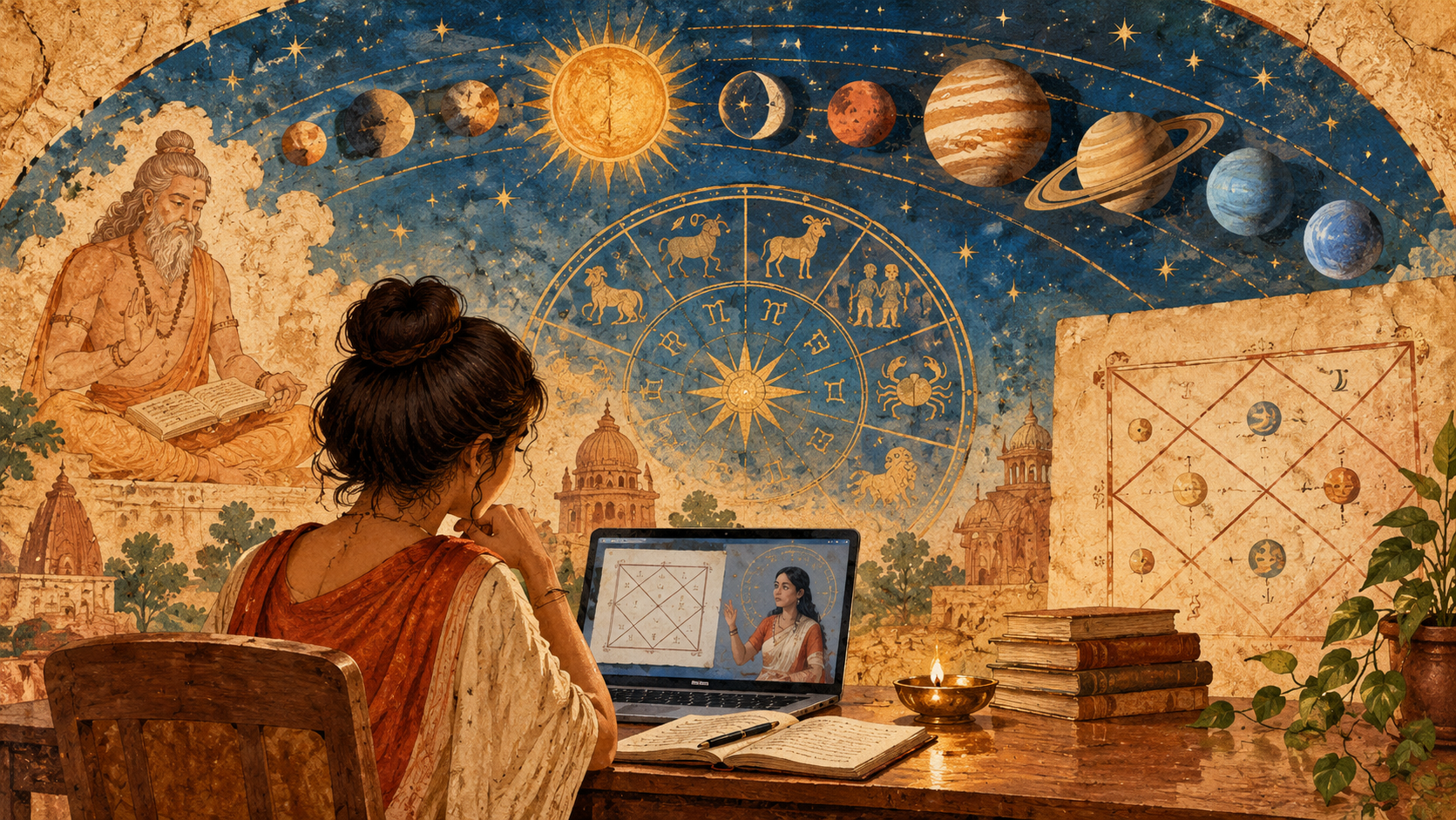
Yes, you can learn Vedic astrology online. Start with the nine planets, twelve signs and twelve houses, then learn to read a birth chart, then timing through dashas and transits. A live course, where you can ask questions, works better than videos alone. Most people need three to six months for the basics and a year or two of practice to read charts with confidence.
This guide is for complete beginners, wherever you live. It covers what to learn, in what order, how long it takes, and how to pick a course without wasting money.
What is Vedic astrology?
Vedic astrology, also called Jyotish, is the traditional astrology of India. It reads a birth chart, which is a map of where the planets stood at the exact time and place a person was born, to understand character, timing and the main themes of a life.
Three ideas sit at the base of it:
- Nine grahas. The Sun, Moon, Mars, Mercury, Jupiter, Venus and Saturn, plus Rahu and Ketu, the two points where the Moon’s path crosses the Sun’s path in the sky.
- Twelve signs and twelve houses. Signs (rashis) describe how a planet behaves. Houses (bhavas) describe which area of life it touches, such as work, marriage or health.
- Twenty-seven nakshatras. These are the lunar mansions. The Moon’s nakshatra at birth is the starting point of the dasha system, which is how Vedic astrology times events.
The biggest practical difference from Western astrology is the zodiac. Vedic astrology uses the sidereal zodiac, which follows the actual positions of the stars. Western astrology uses the tropical zodiac, which is tied to the seasons. The two now differ by about 24 degrees, so for most people the Vedic Sun sign is the one before their Western Sun sign.
Vedic astrology also gives more weight to the Moon sign and the rising sign (lagna) than to the Sun sign. So your Vedic chart can show signs you did not expect.
Can you really learn Vedic astrology online?
Yes. Astrology is learned by reading charts, and a chart works just as well on a screen as on paper. Live classes over Zoom can cover the same ground as a classroom, and students from different countries can learn together. Dr. Tanvi Bansal’s online Vedic astrology course is taught this way.
What online does well:
- You can attend from anywhere, at a time that suits your time zone.
- Recordings let you watch a hard topic again, such as dashas.
- Chart software does the calculation, so your time goes into interpretation.
What is harder online:
- Nobody tells you when your reading is off. Without a teacher looking at your practice charts, you can repeat the same mistake for months.
- Free videos are scattered. You may learn nakshatras before you understand houses, and then nothing fits together.
- Astrology has no regulator. Anyone can call themselves a teacher, so you have to judge the teacher yourself. The sections below show how.
What to learn, and in what order
Learn in this order. Each stage depends on the one before it, and skipping ahead is the most common reason beginners get stuck.
| Stage | What you learn | Rough time |
|---|---|---|
| 1. Basics | The nine planets, twelve signs and twelve houses, and what each one stands for | 3 to 6 weeks |
| 2. Reading a chart | The lagna (rising sign), planets in houses, house lords, strong and weak planets | 4 to 8 weeks |
| 3. Nakshatras | The 27 lunar mansions, starting with the Moon’s nakshatra | 3 to 4 weeks |
| 4. Dashas | The Vimshottari dasha system, a 120-year cycle set by the Moon’s nakshatra, which shows when results are likely to appear | 4 to 8 weeks |
| 5. Transits | How planets moving now (gochar) trigger what the birth chart promises | 3 to 4 weeks |
| 6. Yogas and divisional charts | Planet combinations, and the Navamsa (D9) chart for deeper checks | 6 to 10 weeks |
| 7. Practice | Reading real charts, checking them against known events, and learning to speak about them with care | Ongoing |
The times assume a few hours of study each week. Treat them as a guide, not a promise.
How long does it take to learn Vedic astrology?
Plan on three to six months to learn the basics, and one to two years of regular practice before you can read a chart with confidence. There is no exam that marks the finish line. Anyone who promises mastery in a few weeks is selling something.
Three things change your pace:
- Hours per week. Three to four hours of steady study and practice beats one long session a month.
- Charts you actually read. Most of the learning happens when you work on real charts, not when you read about them. Use charts of family, friends and public figures whose life events you already know, with permission where it applies.
- Someone to correct you. A teacher or a study group catches mistakes early, before they become habits.
Free resources or a paid course?
Start free if you like, but expect to pay for structure at some point. Free material is enough to find out whether the subject interests you. It rarely takes you from the basics to a working reading.
| What you get | Free (videos, blogs, books) | Structured course |
|---|---|---|
| Cost | Nothing, or the price of a book | Usually a fee per level |
| Order of topics | You decide, which often leaves gaps | Set by the teacher |
| Feedback on your charts | None | Yes, in a live course |
| Best for | Testing your interest | Learning to read charts properly |
Classical texts such as the Brihat Parashara Hora Shastra are the base of Vedic astrology. Read them in a good translation once you know the basics, and ideally with a teacher. They are dense, and they were written for readers who already knew the method.
How to choose an online Vedic astrology course
Check these five things before you pay.
- Live or recorded. Recordings are good for revision, but live classes let you ask questions and get corrections. If a course is only recorded, ask how you can reach the teacher.
- The teacher’s background. Look for formal study, years of teaching and practice, and a grounding in the classical texts. A big social media following tells you little about how well someone teaches.
- A clear syllabus. The course page should say what each level covers and how many classes it has. Vague promises like “master astrology” are a warning sign.
- Practice and materials. You should know what you will practise on, and whether texts or software are included in the fee.
- What the certificate means. Most astrology certificates come from the school that runs the course. They are not government degrees and should not be sold as one. Their value comes from who taught you and what you can do afterwards.
Red flags to walk away from:
- Guaranteed results, or “become a professional in 7 days.”
- Pressure to buy gemstones, rituals or paid remedies on the side.
- No clear information on fees, schedule or refunds before you pay.
- A teacher who claims to predict everything with certainty.
You can check Dr. Tanvi Bansal’s live online course against this list. It is taught live, each level has a published syllabus, and the fees are shown on the page.
Tools and books you actually need
You do not need much to start.
- Chart software. Any program that casts a sidereal chart with the Lahiri ayanamsa, the standard setting in India, will do. Jagannatha Hora is free and widely used. Paid programs such as Parashara’s Light offer more features.
- A practice notebook. For each chart, write down your reading and, later, what actually happened. This is how you find out what works.
- One classical text in translation. The Brihat Parashara Hora Shastra is the usual first choice.
- A birth time you trust. An error of an hour or two can change the rising sign, and that changes every house in the chart.
Common mistakes beginners make
- Jumping to dashas and predictions too early. Timing makes sense only after you can read the chart itself.
- Memorising rules without connecting them. A planet’s meaning changes with its sign, its house, its strength and the planets around it. One rule on its own is rarely the answer.
- Mixing Western and Vedic methods. They use different zodiacs and different techniques. Pick one system and learn it properly first.
- Trusting a wrong birth time. If the time is off, the houses in the chart can shift and the reading goes with them.
- Making fearful predictions. A responsible reading talks about tendencies and timing, not fixed outcomes. It never replaces medical, legal or financial advice.
- Studying alone for too long. You can read for months without noticing that you make the same mistake in every chart.
Learning with Dr. Tanvi Bansal
Dr. Tanvi Bansal holds a PhD in Astrology, has taught and practised Vedic astrology for more than 15 years, and is the General Secretary of AIFAS. Her courses follow the order described above: basics first, then chart reading, then timing and practice.
Her live online Vedic astrology course runs on Zoom for students in India and abroad. It has three certification levels, Jyotish Ratna, Jyotish Bhushan and Jyotish Prabhakar, with 12 live classes in each level, taught in Hindi and English. Every class is recorded, course texts are included in the fee, and you can book a free demo class before you decide. Prices start at ₹10,000 per level, and the page also shows the fees for students outside India.
If you are not ready for a course, you can book a personal consultation and see how a chart reading works.
Frequently asked questions
Can I learn Vedic astrology online for free?
Yes, you can learn the basics for free from books, blogs and videos. The limit is structure and feedback: free material rarely tells you what to learn next, and nobody checks your charts. Many people start free and move to a course when they get stuck.
How long does it take to learn Vedic astrology?
About three to six months for the basics, and one to two years of regular practice to read charts with confidence. The pace depends on how many hours you study each week and how many real charts you practise on.
Can I join an online Vedic astrology course from outside India?
Yes. Classes run live on Zoom, so you can join from any country. Dr. Tanvi Bansal’s Vedic astrology course for international students is open to students in India and abroad, and every class is recorded in case the time zone makes a live class hard to attend.
Is Vedic astrology different from Western astrology?
Yes. Vedic astrology uses the sidereal zodiac and the dasha system for timing, and gives more weight to the Moon sign and the rising sign. Western astrology uses the tropical zodiac, so a person’s Sun sign is often one sign earlier in Vedic astrology.
Do I need to know Sanskrit or mathematics?
No. Chart software does the calculations, and a good course teaches the Sanskrit terms as you go. Basic arithmetic helps with a few topics, such as working out dasha periods by hand.
Is a live course better than a recorded one?
For most beginners, yes. In a live class you can ask questions and get your practice charts corrected. Recordings are useful for revision and for classes you miss.
Is an online astrology certificate valid?
It is valid as a certificate from the school that issues it. It is not a government degree, and its value depends on the teacher and the skill you build. Ask who issues the certificate and what you will be able to do with it.
Can I become a professional astrologer after an online course?
A course gives you the foundation. Reading for clients needs more practice on real charts, usually a year or more, along with care in how you speak about health, money and relationships. A sensible way to build up is to read for friends and family first, then for clients.
What do I need to get started?
A computer or phone, a stable internet connection, chart software, and your own birth details: date, time and place. It helps a lot to know your birth time to the minute, or as close as you can get.
Ready to start?
The quickest next step is a free demo class. You will see how a live class runs and can ask your questions before you pay. Book a free demo class on the course page, where you can also check the levels and fees.