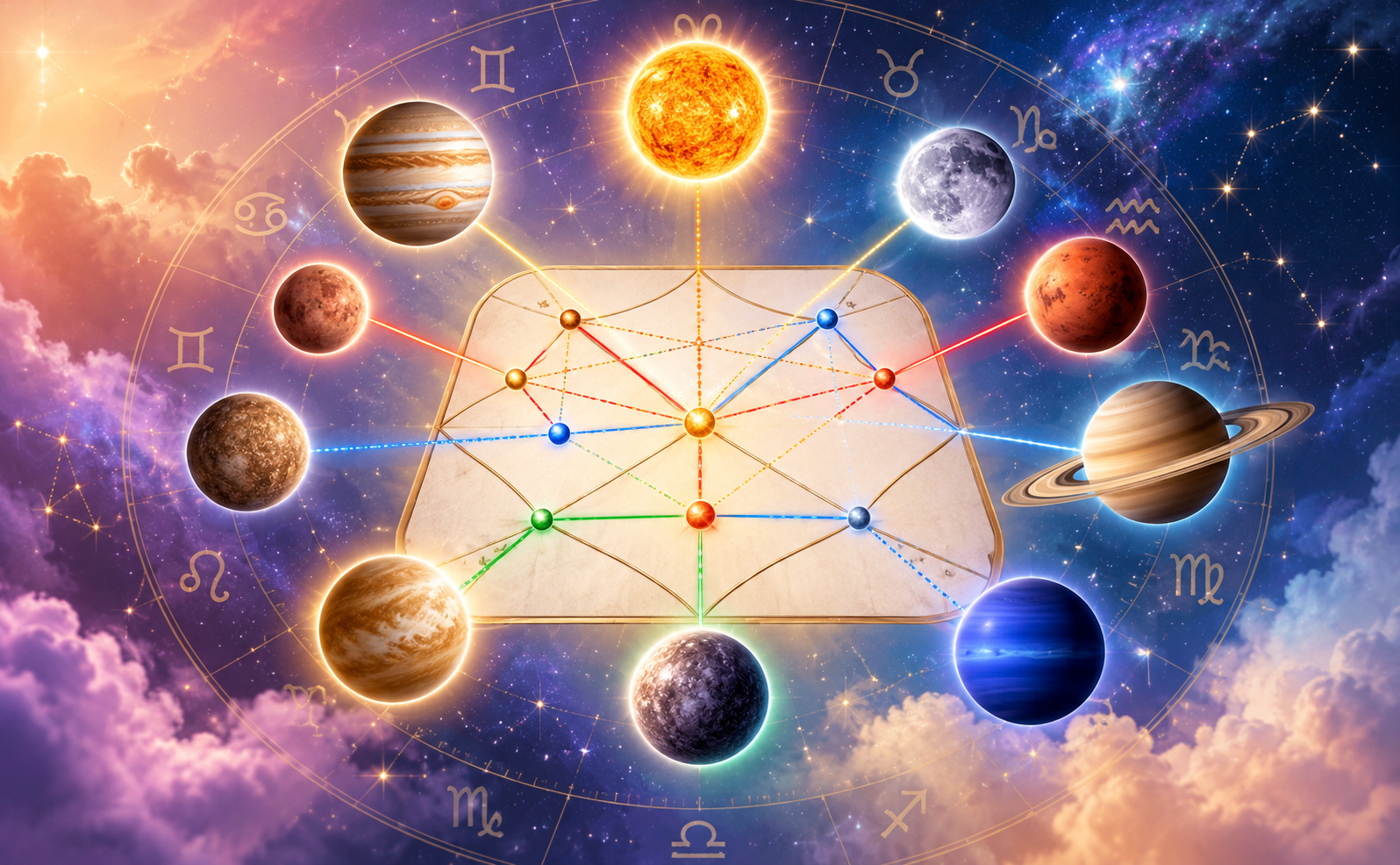
Short answer: In Vedic astrology, a planet’s aspect (Graha Drishti) is the way a planet “looks at” other houses and the planets in them. Every planet aspects the 7th house from where it sits. Mars also aspects the 4th and 8th houses, Jupiter the 5th and 9th, and Saturn the 3rd and 10th. A planet’s aspect adds its influence to that house.
A planet does not only act in the house where it sits. It also sends its influence to other houses. This is called an aspect, or Graha Drishti in Sanskrit. Aspects are one of the first things you must learn after the signs, houses and planets. Without aspects, a chart reading is only half done.
If you are new to charts, first read How to Read a Kundli. That guide explains the Lagna, houses and planets used in this article.
What Is a Planetary Aspect in Vedic Astrology?
An aspect is a link between a planet and a house at a fixed distance. The planet “sees” that house. Any planet sitting in that house also comes under its view.
Think of it like a lamp in a room. The lamp lights its own corner the most. But its light also reaches other corners. In the same way, a planet affects its own house the most, and it also touches the houses it aspects.
Three key points:
- Aspects are counted by houses, not by degrees. This is the simple method used by most Vedic teachers.
- Aspects go forward in the order of the houses.
- A planet does not aspect the house it sits in. It aspects other houses.
How to Count an Aspect
Start from the house where the planet sits. Count that house as number 1. Then count forward to the house you need.
Example: Jupiter is in the 9th house. To find its 5th aspect, count 9th = 1, 10th = 2, 11th = 3, 12th = 4, 1st = 5. So Jupiter aspects the 1st house.
The Rules: Which Houses Does Each Planet Aspect?
All planets have the 7th aspect. Three planets also have special aspects. This is the standard rule in the Parashari system.
| Planet | Aspects (counted from its own house) | Special aspects |
|---|---|---|
| Sun | 7th | None |
| Moon | 7th | None |
| Mercury | 7th | None |
| Venus | 7th | None |
| Mars | 4th, 7th, 8th | 4th and 8th |
| Jupiter | 5th, 7th, 9th | 5th and 9th |
| Saturn | 3rd, 7th, 10th | 3rd and 10th |
| Rahu and Ketu | Schools differ. Many use 5th, 7th and 9th. | Not agreed by all |
For Rahu and Ketu, teachers do not agree. Some give them no aspects at all. Others give them the 5th, 7th and 9th, like Jupiter. A beginner can note this difference and follow what their teacher uses.
Quick reference: where does the 7th aspect fall?
The 7th aspect always lands on the house directly opposite.
| Planet in house | 1 | 2 | 3 | 4 | 5 | 6 | 7 | 8 | 9 | 10 | 11 | 12 |
|---|---|---|---|---|---|---|---|---|---|---|---|---|
| 7th aspect on house | 7 | 8 | 9 | 10 | 11 | 12 | 1 | 2 | 3 | 4 | 5 | 6 |
Special Aspects of Mars, Jupiter and Saturn
Mars: 4th, 7th and 8th
Mars is the planet of energy and action. Its aspect adds drive, speed and sometimes heat or conflict to the house it sees. Mars in the 1st house sees the 4th, 7th and 8th houses.
Jupiter: 5th, 7th and 9th
Jupiter is the planet of wisdom and growth. It is a natural benefic. Its aspect is traditionally taken as supportive. It adds growth, guidance and protection to the houses it sees. Jupiter in the 1st house sees the 5th, 7th and 9th houses.
Saturn: 3rd, 7th and 10th
Saturn is the planet of discipline, delay and hard work. Its aspect brings pressure, seriousness and slow, steady results. Saturn in the 1st house sees the 3rd, 7th and 10th houses. 1 Sa 2 3 4 5 6 7 8 9 10 11 12 Saturn (Sa) in the 1st house aspects the 3rd, 7th and 10th houses (shaded).
Worked Example
This is an illustrative example, not a real person’s chart.
Imagine a chart with Libra Lagna, Saturn in the 1st house and Jupiter in the 9th house.
- Houses: 1st = Libra, 3rd = Sagittarius, 5th = Aquarius, 7th = Aries, 9th = Gemini, 10th = Cancer.
- Saturn in the 1st house aspects the 3rd, 7th and 10th houses. These are Sagittarius, Aries and Cancer.
- Jupiter in the 9th house aspects the 1st, 3rd and 5th houses (5th, 7th and 9th from the 9th house). These are Libra, Sagittarius and Aquarius.
- What you notice: The 1st house gets Jupiter’s aspect. The 3rd house gets both Saturn and Jupiter. Planets in those houses would feel both influences.
This is how you begin a reading. List which planets look at which houses. Then ask what each aspecting planet means and how strong it is.
Benefic and Malefic Aspects
In the traditional view, planets are grouped by nature:
- Natural benefics: Jupiter, Venus, a well-placed Mercury, and a waxing (bright) Moon.
- Natural malefics: Saturn, Mars, Sun, Rahu and Ketu.
A benefic aspect is usually taken as supportive. A malefic aspect is usually taken as pressure or a test. But this is only a starting point. A malefic can give discipline and results, and a benefic can overdo things. Always read the aspect with the sign, house, house lordship and the dasha.
Aspects Between Planets (Not Only Houses)
When a planet aspects a house, it also aspects any planet in that house. This is how planets influence each other. For example, if Saturn aspects the 7th house and Venus sits there, Saturn is aspecting Venus. Read Venus’s results with that influence in mind.
Other Aspect Systems
- Parashari (Graha Drishti): The system explained above. It is the most common one.
- Partial aspects: Some classical texts also describe partial aspects of different strengths. Many modern teachers use only the simple full-aspect rules.
- Jaimini (Rashi Drishti): Here signs aspect signs, not planets. Movable signs aspect fixed signs, except the one next to them. Fixed signs aspect movable signs, except the one next to them. Dual signs aspect the other dual signs.
As a beginner, learn the Parashari rules well first. Then add other systems.
Common Mistakes Beginners Make
- Forgetting to count the planet’s own house as 1. This gives the wrong house every time.
- Counting backward. Aspects are counted forward in house order.
- Ignoring the 7th aspect. Every planet has it, not only Mars, Jupiter and Saturn.
- Calling a malefic aspect “bad”. It needs context.
- Reading aspects alone. Aspects work together with signs, houses, lords and dashas.
How Reliable Is Aspect Reading?
Astrology is a traditional system. Its predictions are not proven by modern scientific studies. Many people use it for reflection and self-understanding. Do not use a chart as the only basis for health, legal or money decisions.
Learn Vedic Astrology Online in English
Aspects look simple in a table, but they get hard when you use them on real charts. A teacher helps you practise on many charts and correct your mistakes early.
Dr. Tanvi Bansal teaches live classes for students who want to learn Vedic astrology online in English. She has a PhD, is the General Secretary of AIFAS, and teaches at Future Point. The classes are taught in four levels, in a small group or one-to-one. You can book a free demo class first. See the online Vedic astrology course in English for levels, fees and timings.
If you are looking for a way to learn a Vedic astrology course online, check these before you join any class:
- Is the teacher’s background and experience clearly shown?
- Is there a clear syllabus by level?
- Are classes live, so you can ask questions?
- Can you try a demo class before you pay?
- Is the refund policy clear?
Continue Learning
- How to Read a Kundli: A Complete Beginner’s Guide
- What Is Vedic Astrology?
- How to Learn Vedic Astrology as a Beginner
Frequently Asked Questions
What is a planetary aspect in Vedic astrology?
It is the way a planet influences other houses from where it sits. In Sanskrit it is called Graha Drishti, which means the “sight” of a planet.
Which houses does every planet aspect?
Every planet aspects the 7th house from its own position, counting its own house as 1.
What are the special aspects of Mars, Jupiter and Saturn?
Mars aspects the 4th, 7th and 8th houses. Jupiter aspects the 5th, 7th and 9th houses. Saturn aspects the 3rd, 7th and 10th houses.
Do Rahu and Ketu have aspects?
Teachers differ. Some give them no aspects, and many give them the 5th, 7th and 9th houses. Follow the rule your teacher uses and apply it consistently.
How do I count an aspect?
Start from the planet’s house and count it as 1. Count forward in house order until you reach the aspect number. For example, the 5th aspect of Jupiter in the 9th house falls on the 1st house.
Is a planet’s aspect on a house the same as being in that house?
No. A planet in a house has the strongest effect on it. An aspect adds a weaker, added influence.
Is a malefic aspect always bad?
No. A malefic aspect often brings pressure or tests, but it can also give discipline and results. Read it with the sign, house and dasha.
Where can I learn Vedic astrology online in English?
You can join live online classes taught in English. Dr. Tanvi Bansal offers a Vedic astrology course online in four levels, with a free demo class. See the course page for details.
About the Author
Dr. Tanvi Bansal is a Vedic astrologer with a PhD. She is the General Secretary of AIFAS and teaches Vedic astrology at Future Point. She teaches students in India and abroad through live online classes in English.