

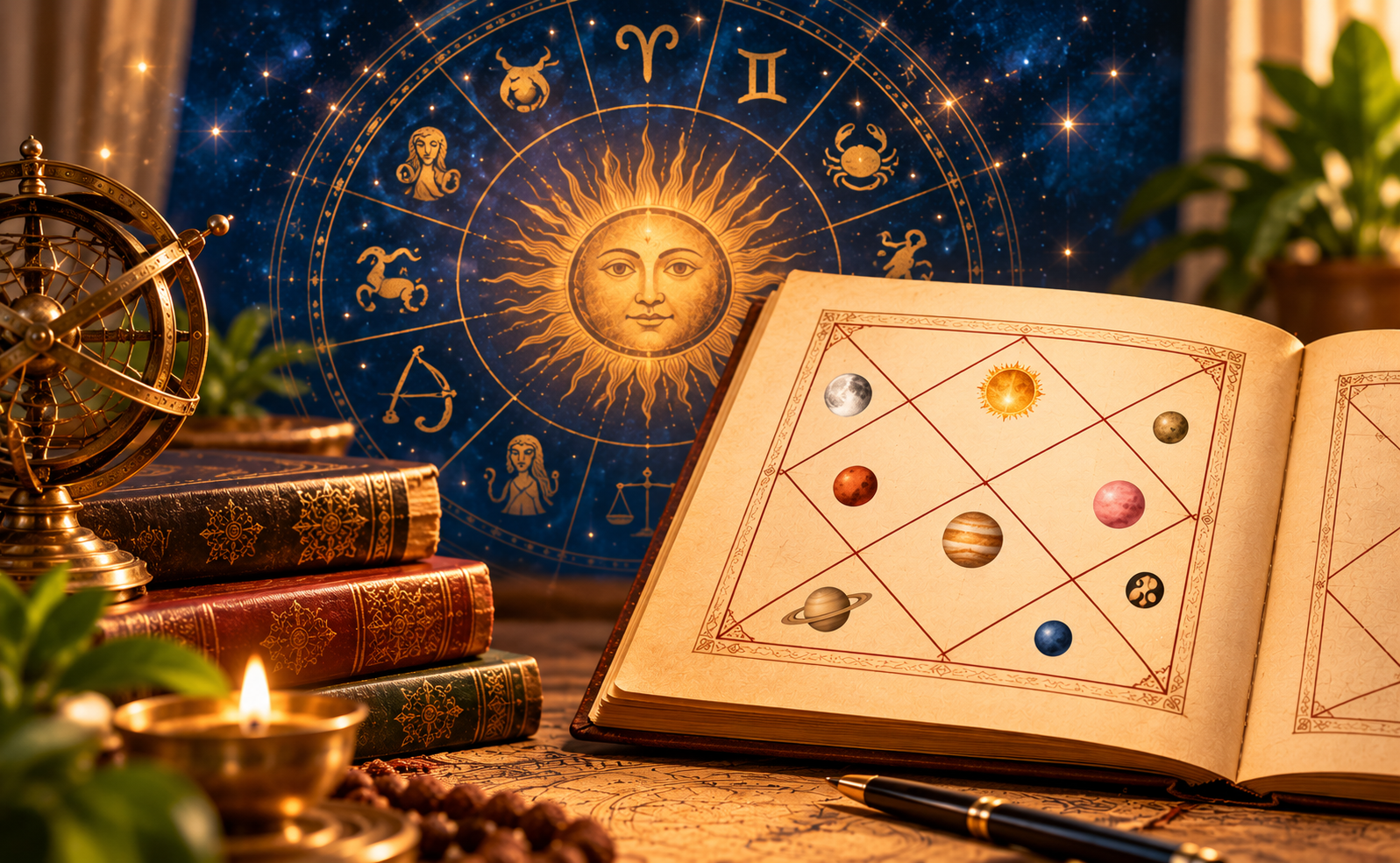
Short answer: To read a kundli (Vedic birth chart), first find the Lagna (rising sign), then number the 12 houses from it. Next, see which sign and house each of the 9 planets sits in. Then check the Moon’s nakshatra and the current dasha (planetary period). Read the chart in this order: Lagna, houses, planets, nakshatra, dasha.
A kundli looks confusing the first time. It is a box with numbers and short planet names, and it has no labels. This guide explains it one step at a time, in plain English. You do not need any earlier knowledge.
If you want the basics first, read What Is Vedic Astrology? before this guide. After this guide, you can go deeper into each topic using the links in the last section.
What Is a Kundli?
A kundli (also called Janam Kundali, birth chart or horoscope) is a map of the sky at the exact moment and place you were born. It shows where the Sun, Moon and other planets were, and which zodiac sign was rising on the eastern horizon.
Vedic astrology uses the sidereal zodiac. This zodiac is fixed to the stars. Western astrology mostly uses the tropical zodiac, which is fixed to the seasons. The gap between the two is called the ayanamsa. It is currently about 24 degrees. In India, the most common ayanamsa is the Lahiri ayanamsa. Because of this gap, your Vedic Sun sign is often the sign before your Western Sun sign.
What You Need Before You Start
- Date of birth
- Exact time of birth (as exact as possible)
- Place of birth (city and country)
Birth time matters a lot. The rising sign changes about every two hours. A few minutes can also change the finer details of the chart. If the time is wrong, the houses and the dasha timing can be wrong too.
You can create a kundli with any free Vedic astrology software. Choose the Lahiri ayanamsa and the whole sign house system. This is the simplest setup for a beginner.
Step 1: Know the Chart Style
A kundli is drawn in one of three styles. The two most common are the North Indian and South Indian styles. The planets and signs are the same. Only the drawing is different.
| North Indian | South Indian | |
|---|---|---|
| Shape | Square with a diamond inside | Square with 12 small boxes |
| What is fixed | The houses. The 1st house is always the top middle diamond. | The signs. Aries is always the second box from the left in the top row. |
| What changes | The sign numbers inside each house | Which box holds the Lagna |
| How to find the Lagna | The top middle box | The box marked “Asc” or “Lg” |
| Direction | Houses go anticlockwise | Signs go clockwise |
1 2 3 4 5 6 7 8 9 10 11 12 North Indian chart layout. The numbers are the house numbers. House 1 is the top middle diamond. Houses go anticlockwise.
Step 2: Find the Lagna (Rising Sign)
The Lagna is the zodiac sign that was rising on the eastern horizon when you were born. It is the starting point of the whole chart. The sign of the Lagna becomes your 1st house.
- In a North Indian chart, the number written in the top middle diamond is the Lagna sign (1 = Aries, 2 = Taurus, and so on up to 12 = Pisces).
- In a South Indian chart, look for the box with the mark “Asc” or “Lg”.
Every other house is counted from the Lagna. This is why the Lagna comes first. If you get it wrong, every house after it is wrong.
Step 3: Learn the 12 Signs and Their Lords
Each sign is ruled by a planet. This ruling planet is called the sign lord. You will use this table many times.
| No. | Sign | Sanskrit name | Lord |
|---|---|---|---|
| 1 | Aries | Mesha | Mars |
| 2 | Taurus | Vrishabha | Venus |
| 3 | Gemini | Mithuna | Mercury |
| 4 | Cancer | Karka | Moon |
| 5 | Leo | Simha | Sun |
| 6 | Virgo | Kanya | Mercury |
| 7 | Libra | Tula | Venus |
| 8 | Scorpio | Vrischika | Mars |
| 9 | Sagittarius | Dhanu | Jupiter |
| 10 | Capricorn | Makara | Saturn |
| 11 | Aquarius | Kumbha | Saturn |
| 12 | Pisces | Meena | Jupiter |
Step 4: Understand the 12 Houses
Each house stands for an area of life. The 1st house is the Lagna sign. The 2nd house is the next sign, and so on, in order.
| House | Main themes |
|---|---|
| 1st | Self, body, personality, general direction of life |
| 2nd | Family, speech, savings, food |
| 3rd | Courage, siblings, skills, short travel, effort |
| 4th | Mother, home, property, vehicles, inner peace |
| 5th | Children, education, creativity, intelligence |
| 6th | Work routine, health issues, debts, competition |
| 7th | Marriage, partnerships, business partners |
| 8th | Change, sudden events, longevity, hidden matters |
| 9th | Luck, higher learning, teachers, father, long travel |
| 10th | Career, status, public life, actions |
| 11th | Income, gains, friends, goals |
| 12th | Expenses, losses, foreign lands, sleep, letting go |
Some houses are grouped for easy memory:
- Kendra (angles): 1, 4, 7, 10. These are the strong, active houses.
- Trikona (trines): 1, 5, 9. These are the houses of good fortune.
- Dusthana (difficult houses): 6, 8, 12. These show struggle, change and loss.
Step 5: Meet the 9 Planets (Grahas)
Vedic astrology uses nine grahas. Rahu and Ketu are not physical planets. They are the two points where the Moon’s path crosses the Sun’s path. They are called the lunar nodes.
| Planet | Short name in chart | Main significations |
|---|---|---|
| Sun (Surya) | Su | Soul, authority, father, confidence |
| Moon (Chandra) | Mo | Mind, emotions, mother, comfort |
| Mars (Mangal) | Ma | Energy, courage, action, siblings |
| Mercury (Budha) | Me | Speech, intellect, business, learning |
| Jupiter (Guru) | Ju | Wisdom, teachers, children, growth |
| Venus (Shukra) | Ve | Love, comfort, arts, relationships |
| Saturn (Shani) | Sa | Discipline, delay, hard work, responsibility |
| Rahu | Ra | Desire, ambition, foreign things, confusion |
| Ketu | Ke | Detachment, past habits, spirituality |
A simple way to remember: the planet shows what, the sign shows how, and the house shows where. For example, Mars (what: energy) in Leo (how: with pride and confidence) in the 10th house (where: career).
Step 6: Read Each Planet by Sign and House
Now take one planet at a time. Ask three questions:
- Which house is it in? This shows the area of life it affects.
- Which sign is it in? Is the sign friendly to the planet, or not?
- Which houses does it rule? Every planet is the lord of one or two houses, based on the signs it owns.
Planet strength: exaltation and debilitation
A planet is usually stronger in some signs and weaker in others.
| Planet | Exalted (strong) in | Debilitated (weak) in |
|---|---|---|
| Sun | Aries | Libra |
| Moon | Taurus | Scorpio |
| Mars | Capricorn | Cancer |
| Mercury | Virgo | Pisces |
| Jupiter | Cancer | Capricorn |
| Venus | Pisces | Virgo |
| Saturn | Libra | Aries |
A weak planet is not always “bad”. Other factors can change the result. Beginners should not judge a planet from its sign alone.
Planets that look at each other (aspects)
In Vedic astrology, planets “see” certain houses from where they sit. This is called drishti.
- Every planet sees the 7th house from itself.
- Mars also sees the 4th and 8th houses.
- Jupiter also sees the 5th and 9th houses.
- Saturn also sees the 3rd and 10th houses.
When two planets are in the same sign, it is called a conjunction. Their effects mix.
Step 7: Check the Moon’s Nakshatra
The zodiac is also divided into 27 nakshatras (lunar mansions). Each nakshatra is 13 degrees 20 minutes wide. Your birth nakshatra is the one the Moon was in when you were born.
The nakshatra adds detail about your mind and nature. It is also the base for calculating your dasha timeline.
Step 8: Find the Current Dasha
A dasha is a planetary period. The most common system is Vimshottari Dasha. It divides a 120-year cycle among the nine planets. The order and length of the periods are fixed:
| Planet | Years |
|---|---|
| Ketu | 7 |
| Venus | 20 |
| Sun | 6 |
| Moon | 10 |
| Mars | 7 |
| Rahu | 18 |
| Jupiter | 16 |
| Saturn | 19 |
| Mercury | 17 |
Which planet starts your life depends on the Moon’s nakshatra at birth. Software calculates this for you. In a traditional reading, the planet running the current dasha shows which parts of the chart become active at that time. Beginners do not need to calculate it by hand. Just learn to find the current dasha planet and ask: which houses does it sit in and rule?
A Simple Worked Example
This is an illustrative example, not a real person’s chart. It is simplified to show the method.
Imagine a chart with Libra Lagna and Saturn in the 1st house.
- Lagna: Libra. So the 1st house is Libra.
- Count the houses: 2nd = Scorpio, 3rd = Sagittarius, 4th = Capricorn, 5th = Aquarius, 6th = Pisces, 7th = Aries, 8th = Taurus, 9th = Gemini, 10th = Cancer, 11th = Leo, 12th = Virgo.
- Planet: Saturn sits in Libra, in the 1st house.
- Sign strength: Libra is Saturn’s exaltation sign (see the table above). So Saturn is strong here.
- Houses it rules: Saturn owns Capricorn (4th house) and Aquarius (5th house). So Saturn rules the 4th and 5th houses for this Lagna.
- Reading: A strong Saturn in the 1st house links self (1st) with home and education (4th and 5th). A student of astrology would note this as a point to study further. It would not be a final judgment by itself.
This is the method in short: Lagna, then house, then sign, then lord, then repeat for each planet. A real reading also looks at aspects, conjunctions, divisional charts and the dasha. That is why practice matters more than memory.
Common Mistakes Beginners Make
- Reading only the Sun sign. In Vedic astrology, the Lagna and the Moon sign matter more.
- Using a wrong birth time. This changes the Lagna and every house.
- Judging one planet alone. A planet must be seen with its sign, house, lordship and aspects.
- Mixing zodiacs. Do not use a Western tropical chart for a Vedic reading.
- Memorising too many rules. Practise on a few real charts instead.
- Getting scared by “bad” placements. No placement is good or bad in isolation.
- Predicting too early. Learn to describe a chart before you try to predict from it.
How Reliable Is Kundli Reading?
Astrology is a traditional system of knowledge. Its predictions are not proven by modern scientific studies. Many people use it for reflection, planning and self-understanding. Do not use a kundli as the only basis for medical, legal or financial decisions. Always speak to a qualified professional for those.
A Simple Practice Plan
- Generate your own kundli with the Lahiri ayanamsa.
- Write down your Lagna, Moon sign and Moon nakshatra.
- Number the 12 houses and write the sign of each.
- Write where each of the 9 planets sits.
- Note which planets are exalted or debilitated.
- Find your current Vimshottari dasha planet.
- Repeat this with the charts of 5 family members or friends (with their permission).
Learn More: Go Deeper Into Each Topic
This guide is the foundation. Each topic below has its own detailed guide.
Learn This With a Teacher
If you want to learn kundli reading in a structured way, Dr. Tanvi Bansal teaches live online classes in English. She holds a PhD, is the General Secretary of AIFAS, and teaches at Future Point. See the online Vedic astrology course in English for levels, fees and the free demo class.
Frequently Asked Questions
Can a beginner read their own kundli?
Yes, a beginner can read the basics: the Lagna, the houses, the signs and the planet positions. A detailed reading needs training and practice, because planets must be read together, not one by one.
What do I need to make a kundli?
You need your date, exact time and place of birth. The time should be as accurate as possible, because the Lagna changes about every two hours.
What is the first thing to check in a kundli?
Check the Lagna (rising sign) first. All 12 houses are counted from it.
What is the difference between a North Indian and a South Indian chart?
The information is the same. In the North Indian style, the houses are fixed and the signs move. In the South Indian style, the signs are fixed and the Lagna moves.
Which matters more: Lagna or Moon sign?
Both matter. The Lagna decides the houses and the base of the chart. The Moon sign and nakshatra are used for the mind and for the dasha timeline.
What if I do not know my birth time?
Without a birth time, the Lagna and houses cannot be fixed. Astrologers sometimes use birth time rectification, which estimates the time from past life events. This method is itself debated, so treat the result with care.
How long does it take to learn kundli reading?
It depends on how much you practise. You can learn the basics in a few weeks. Reading a chart with confidence takes much longer and needs regular practice on real charts.
Are kundli predictions scientifically proven?
No. Modern scientific studies have not established that astrological predictions work. Astrology is a traditional system that many people use for reflection and guidance.
About the Author
Dr. Tanvi Bansal is a Vedic astrologer with a PhD. She is the General Secretary of AIFAS and teaches Vedic astrology at Future Point. She teaches students in India and abroad through live online classes in English.