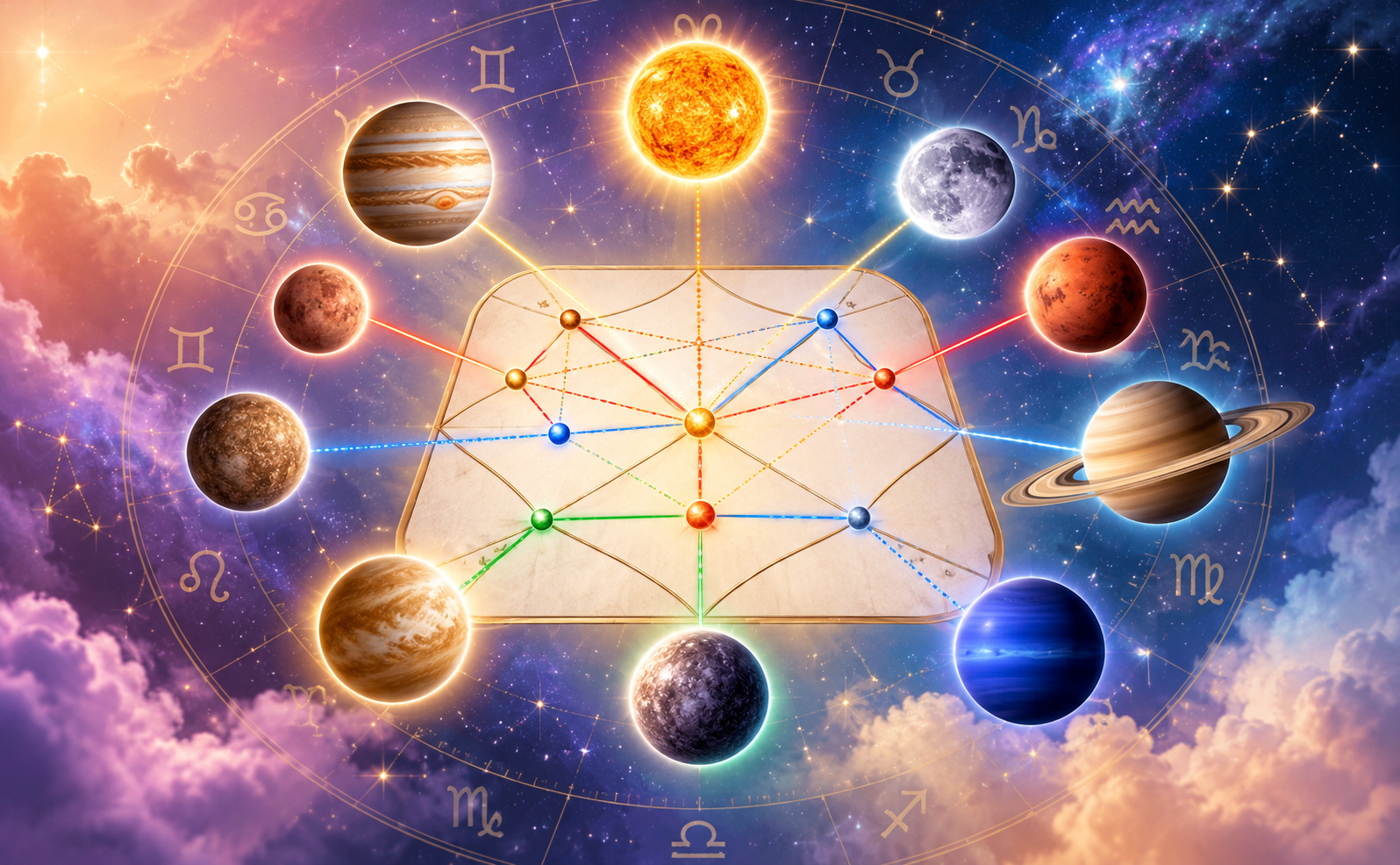
Have you ever wondered why one area of life seems to demand confidence and leadership, while another calls for patience, emotional understanding, or careful decision-making? In Vedic astrology, the nine grahas, known as the Navagraha, offer a traditional framework for exploring these different dimensions of human experience.
The nine planets in Vedic astrology are the Sun (Surya), Moon (Chandra), Mars (Mangala), Mercury (Budha), Jupiter (Guru), Venus (Shukra), Saturn (Shani), Rahu, and Ketu. Each represents particular themes, such as identity, emotions, courage, communication, wisdom, relationships, discipline, ambition, and spiritual growth.
Understanding the Navagraha is one of the foundations of learning Vedic astrology, also known as Jyotish. However, a planet’s meaning cannot be interpreted in isolation. Its sign, house placement, planetary relationships, strength, and timing periods all contribute to a complete birth chart interpretation.
In this guide, you will learn what each of the nine grahas represents and how astrologers traditionally interpret them in a birth chart.
What Are the 9 Planets in Vedic Astrology?
The nine planets in Vedic astrology are collectively called the Navagraha. The Sanskrit word nava means nine, while graha refers to a planetary influence within the traditional astrological system.
Unlike modern astronomy, which classifies the Sun as a star and the Moon as Earth’s natural satellite, Jyotish uses the word “planet” in a traditional astrological sense. Rahu and Ketu are the north and south lunar nodes, respectively, rather than physical planets.
| Graha | Sanskrit Name | Main Astrological Meaning |
|---|---|---|
| Sun | Surya | Identity, confidence, authority and vitality |
| Moon | Chandra | Mind, emotions, comfort and adaptability |
| Mars | Mangala | Courage, action, energy and initiative |
| Mercury | Budha | Intellect, communication, learning and trade |
| Jupiter | Guru or Brihaspati | Wisdom, knowledge, ethics and expansion |
| Venus | Shukra | Love, relationships, beauty and enjoyment |
| Saturn | Shani | Discipline, responsibility, patience and perseverance |
| Rahu | Rahu | Ambition, unconventional pursuits and material desires |
| Ketu | Ketu | Detachment, introspection and spiritual inquiry |
These meanings are traditional astrological interpretations, not scientifically established measurements of personality or future events.
1. Sun (Surya): Identity, Confidence and Leadership
In Vedic astrology, the Sun represents the core self, vitality, authority, confidence, and the desire to make a meaningful contribution. It is associated with leadership, recognition, independence, and one’s relationship with responsibility.
The Sun is particularly relevant when examining how a person expresses authority, develops self-confidence, and approaches leadership.
For example, astrologers may examine the Sun when interpreting a chart for someone interested in management, entrepreneurship, public service, or a position of responsibility.
A well-supported Sun may traditionally be associated with healthy self-respect and responsible leadership. Challenging placements may be interpreted as themes involving pride, recognition, or relationships with authority.
Key themes: Identity, vitality, leadership, authority, confidence, and purpose.
What to examine in a birth chart: The Sun’s sign, house, aspects, conjunctions, and overall strength.
2. Moon (Chandra): Mind, Emotions and Inner Security
The Moon represents the mind, emotional responses, memory, comfort, and the need for security in Vedic astrology. While the Sun is associated with identity and authority, the Moon helps astrologers explore how a person processes experiences and responds to the world around them.
The Moon is especially important in Jyotish because the lunar position is used in several traditional systems of chart interpretation and timing.
Consider someone who handles professional responsibilities confidently but finds uncertainty emotionally difficult. An astrologer might examine the Moon, its house placement, and its relationship with other planets to understand the chart’s emotional themes.
However, the Moon’s placement alone cannot establish a person’s emotional health or psychological condition.
Key themes: Emotions, mental patterns, memory, comfort, adaptability, and the mother.
What to examine in a birth chart: The Moon’s sign, house, phase, planetary aspects, and strength.
3. Mars (Mangala): Courage, Action and Determination
Mars represents energy, initiative, courage, competition, and the willingness to take action. In traditional Vedic astrology, it is associated with the ability to confront challenges, defend boundaries, and pursue goals with determination.
Mars is relevant when astrologers examine themes involving competition, physical effort, technical work, entrepreneurship, and decisive action.
For instance, someone who enjoys taking on difficult projects and making quick decisions might explore Mars as one part of their birth chart interpretation.
When Mars is interpreted as challenged, astrologers may examine themes involving impatience, conflict, impulsive decisions, or the need to manage energy more constructively.
Mars should not automatically be labelled negative simply because it is associated with aggression or conflict. Its interpretation depends on the whole chart.
Key themes: Courage, initiative, energy, competition, determination, and action.
What to examine in a birth chart: Mars’s house, sign, aspects, conjunctions, and relationship with the chart’s other factors.
4. Mercury (Budha): Intelligence, Communication and Learning
Mercury represents communication, reasoning, analytical ability, learning, language, and commerce. It is associated with how information is processed, expressed, and exchanged.
In a birth chart, Mercury is often examined when interpreting interests in writing, teaching, business, mathematics, negotiation, and other communication-intensive activities.
Imagine someone who enjoys analysing information, explaining complicated ideas, and negotiating business deals. An astrologer might study Mercury’s placement alongside the houses associated with communication, education, and profession.
Mercury is also interpreted in relation to adaptability and the ability to understand different perspectives.
Key themes: Intellect, speech, communication, learning, analysis, and trade.
What to examine in a birth chart: Mercury’s sign, house, conjunctions, aspects, and overall condition.
5. Jupiter (Guru): Wisdom, Knowledge and Growth
Jupiter, also known as Guru or Brihaspati, represents wisdom, higher learning, ethics, faith, teaching, and expansion in Vedic astrology.
It is traditionally associated with mentors, teachers, philosophy, spiritual knowledge, and the search for meaning. Jupiter is also examined in relation to prosperity and opportunities for growth, depending on the complete birth chart.
For example, someone pursuing higher education or developing a career in teaching may explore Jupiter’s placement as part of a broader astrological interpretation.
However, Jupiter does not guarantee wealth, success, or good fortune. Its traditional significance must be considered alongside the rest of the chart.
Key themes: Wisdom, education, guidance, ethics, faith, and expansion.
What to examine in a birth chart: Jupiter’s sign, house, aspects, conjunctions, and relationship with relevant house lords.
6. Venus (Shukra): Love, Relationships and Appreciation of Beauty
Venus represents relationships, affection, beauty, art, pleasure, harmony, and enjoyment. It is associated with how people approach connection, attraction, aesthetics, and the comforts of life.
In Vedic astrology, Venus is often considered when examining romantic relationships, artistic interests, design, music, and the appreciation of luxury.
For example, a person interested in creative expression or cultivating harmonious relationships might explore Venus alongside the relevant houses and other planetary influences.
Venus does not determine whether a relationship will succeed. Compatibility and relationship interpretation require a broader examination of the birth charts and the astrological methods being used.
Key themes: Love, attraction, harmony, art, beauty, pleasure, and refinement.
What to examine in a birth chart: Venus’s sign, house, aspects, conjunctions, and relationship with the seventh house and its lord when analysing partnerships.
7. Saturn (Shani): Discipline, Responsibility and Patience
Saturn represents discipline, responsibility, time, perseverance, structure, and the lessons associated with sustained effort. In Vedic astrology, it is frequently linked with long-term commitments, limitations, work, and accountability.
Saturn is often misunderstood as a planet that brings only hardship. Its traditional symbolism also includes patience, maturity, endurance, and the ability to build something that lasts.
Consider someone who spends years developing a professional skill before achieving recognition. An astrologer might interpret Saturn as symbolising the importance of consistent work and long-term responsibility in that person’s chart.
Challenging Saturn placements may traditionally be interpreted through themes of delay, pressure, or excessive restriction. These are not automatic predictions of failure.
Key themes: Discipline, patience, responsibility, persistence, structure, and maturity.
What to examine in a birth chart: Saturn’s sign, house, aspects, conjunctions, strength, and timing periods.
8. Rahu: Ambition, Unconventional Paths and Desire
Rahu is the north lunar node and one of the two shadow grahas in Vedic astrology. Although it is not a physical planet, it plays an important role in traditional birth chart interpretation.
Rahu is associated with ambition, intense desires, unconventional pursuits, fascination with unfamiliar experiences, and the urge to move beyond established boundaries.
Depending on the astrological tradition and chart context, Rahu may also be examined in relation to foreign connections, technology, mass influence, and unusual career paths.
For example, someone pursuing an unconventional profession or exploring opportunities in an unfamiliar culture might examine Rahu’s placement as one interpretive factor.
Rahu is not inherently a guarantee of sudden success or sudden loss. Its meaning depends on its sign, house, associations, dispositor, and the broader chart.
Key themes: Ambition, desire, unconventional interests, experimentation, and worldly pursuits.
What to examine in a birth chart: Rahu’s house, sign, dispositor, conjunctions, aspects, and relationship with Ketu.
9. Ketu: Detachment, Introspection and Spiritual Inquiry
Ketu is the south lunar node. In Vedic astrology, it is associated with detachment, introspection, renunciation, spiritual inquiry, and experiences that encourage a person to question ordinary sources of satisfaction.
Where Rahu is often interpreted through desire and the pursuit of new experiences, Ketu is traditionally associated with withdrawal, inward exploration, and reduced attachment to certain worldly concerns.
For example, someone who feels drawn to meditation, philosophical study, or exploring the deeper meaning of life might examine Ketu’s position within the broader birth chart.
Ketu should not automatically be interpreted as a sign of loss or failure. Its significance depends on the chart as a whole and the particular astrological tradition being followed.
Key themes: Detachment, introspection, spiritual inquiry, renunciation, and unconventional insight.
What to examine in a birth chart: Ketu’s sign, house, dispositor, planetary associations, and relationship with Rahu.
How Do the 9 Planets Work Together in a Birth Chart?
Understanding each graha individually is the starting point. A meaningful Vedic astrology interpretation considers how the planets interact with one another and with the rest of the chart.
Four important factors are particularly useful for beginners.
1. Planetary Sign
A zodiac sign describes the environment or style through which a planet is interpreted.
For example, astrologers may interpret Mars in Aries differently from Mars in Cancer because the two signs have different traditional associations.
2. House Placement
The twelve houses represent different areas of life, such as identity, finances, education, relationships, career, and spiritual matters.
A planet’s house placement helps determine which life areas an astrologer will examine.
3. Planetary Relationships and Strength
Aspects, conjunctions, sign rulership, and traditional measures of planetary strength can change how a planet is interpreted.
A planet cannot be classified as entirely favourable or unfavourable based on its name alone.
4. Dasha and Transits
Vimshottari Dasha and other traditional timing techniques are used to examine planetary periods. Transits consider the apparent movement of planets in relation to a birth chart or another reference point.
Astrologers may combine these techniques when exploring the timing of possible developments. They should not treat an isolated transit or planetary period as a guaranteed prediction.
Why Is It Important to Learn the Navagraha First?
If you want to learn Vedic astrology, understanding the nine grahas gives you a foundation for interpreting birth charts.
Rather than memorising isolated predictions, begin by understanding what each planet represents. Then learn the twelve houses, zodiac signs, planetary relationships, and timing techniques.
A practical learning sequence is:
- Learn the basic meanings of the nine grahas.
- Understand the twelve zodiac signs.
- Study the twelve houses and their significations.
- Learn planetary aspects, conjunctions, and sign rulership.
- Practise interpreting complete birth charts.
- Study Dasha systems and transits after understanding the fundamentals.
This approach helps you move from memorising definitions to understanding how different parts of a birth chart work together.
Frequently Asked Questions
What are the 9 planets in Vedic astrology?
The nine grahas are the Sun (Surya), Moon (Chandra), Mars (Mangala), Mercury (Budha), Jupiter (Guru), Venus (Shukra), Saturn (Shani), Rahu, and Ketu. Rahu and Ketu are the north and south lunar nodes, not physical planets.
What does each planet represent in Vedic astrology?
The Sun represents identity and authority; the Moon, emotions and the mind; Mars, courage and action; Mercury, communication and intellect; Jupiter, wisdom and growth; Venus, love and beauty; Saturn, discipline and responsibility; Rahu, ambition and unconventional desires; and Ketu, detachment and spiritual inquiry.
Are Rahu and Ketu real planets?
No. Astronomically, Rahu and Ketu are the north and south lunar nodes, the points where the Moon’s orbital path crosses the ecliptic. Vedic astrology treats them as grahas within its traditional interpretive system.
Which planet is the most important in Vedic astrology?
There is no single planet that is universally the most important in every birth chart. The ascendant, Moon, Sun, planetary strengths, house rulerships, and the question being examined can all affect an astrologer’s interpretation.
Can one planet determine a person’s future?
Within traditional Vedic astrology, a planet is not interpreted independently of the whole chart. Astrologers consider its sign, house, relationships, strength, and relevant timing periods. Astrological interpretations should not be treated as scientifically established predictions or as substitutes for professional advice.
How should a beginner start learning Vedic astrology?
Start with the nine grahas, twelve zodiac signs, and twelve houses. Next, learn planetary aspects, sign rulership, and birth chart interpretation. Study Dasha systems and transits once you understand these foundations.
Final Thoughts
The nine planets of Vedic astrology provide a traditional framework for exploring identity, emotions, action, communication, wisdom, relationships, responsibility, ambition, and detachment.
The real skill lies not in memorising nine definitions, but in understanding how the grahas interact with signs, houses, and one another within a complete birth chart.
If you are beginning your journey into Jyotish, use this guide as a starting point and continue with the fundamentals of Kundli reading, planetary relationships, and predictive techniques.
Want to learn Vedic astrology systematically? Explore the online Vedic Astrology courses offered by Astro Tanvi Bansal to learn more about birth chart interpretation and traditional Jyotish concepts.
Explore Online Vedic Astrology Courses
About the author: Dr. Tanvi Bansal is a Vedic astrology educator with a PhD in Astrology and more than 15 years of teaching experience. Her educational content introduces learners to traditional Jyotish concepts and birth chart interpretation.